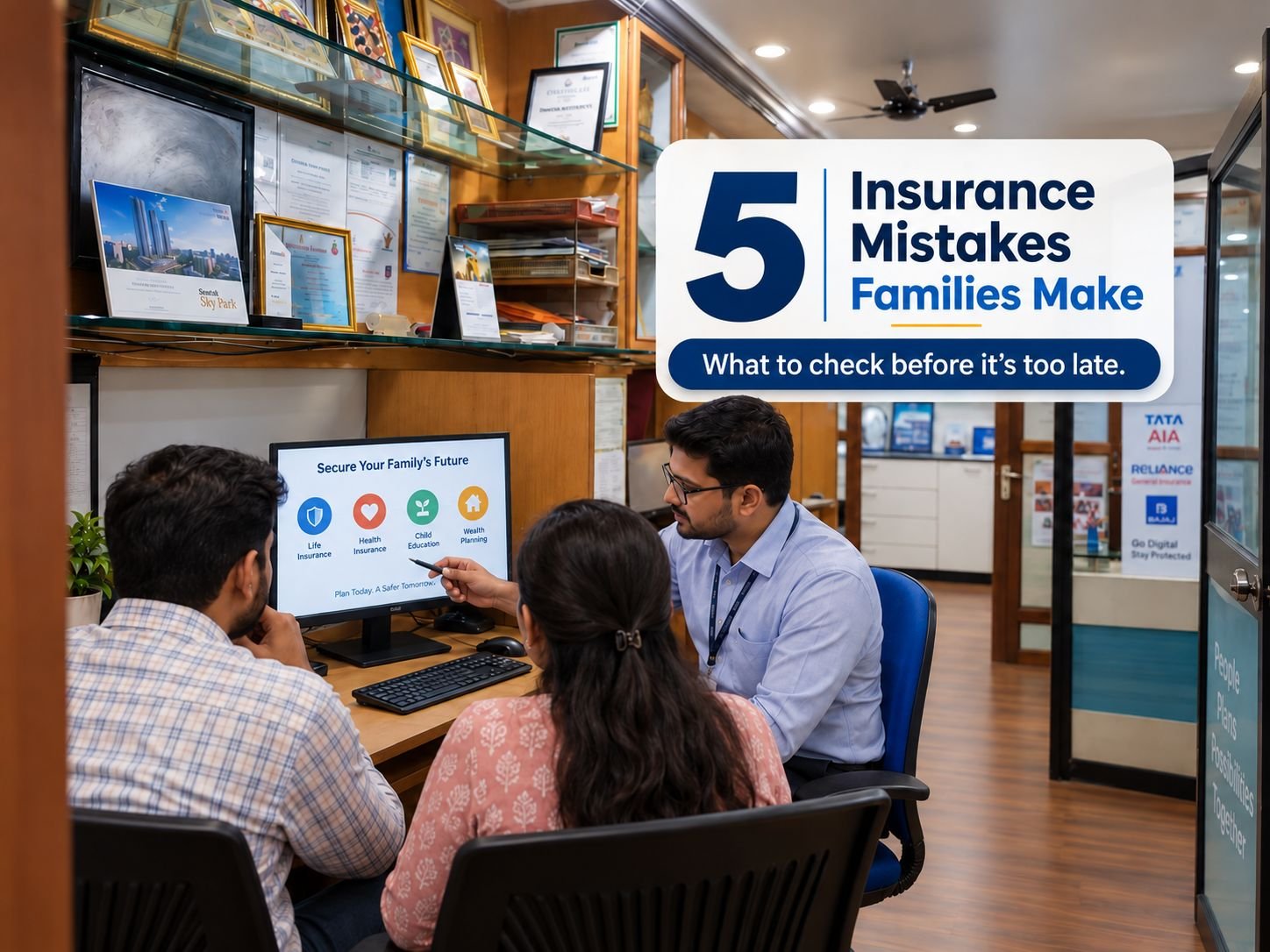
Most families do not discover a gap in their insurance while reading the policy document. They discover it in a hospital corridor, or after a claim gets rejected, when there is no time left to fix anything. The 5 mistakes below are not rare or unusual. They are the default choices most families make, simply because nobody explained the alternative at the time of buying.
This guide walks through each one in plain language, with what to check or do differently instead. It applies whether you already hold a policy or are buying your first one.
Buying insurance as an investment, not protection
Endowment plans, money-back policies and many ULIPs bundle a small amount of life cover with an investment component, and they are sold on the promise of “getting your money back.” The problem is the cover itself is usually tiny relative to the premium.
A pure term plan gives a much larger life cover for a fraction of the premium, precisely because it carries no maturity payout. If you die during the term, your family gets the full sum assured. If you do not, the policy simply ends, and that is by design, not a flaw. Investment and protection solve different problems, and mixing them into one product usually means doing both jobs poorly. A term plan for protection, paired with a mutual fund SIP for wealth building, generally beats a bundled product on both fronts.
Relying only on the health cover your employer provides
Group health insurance through an employer feels like enough cover, since it costs nothing extra and requires no paperwork. It also disappears the moment you change jobs, get laid off, or retire, usually at the exact life stage when new health cover becomes hardest and most expensive to buy.
Employer cover is also frequently smaller than families assume, sometimes as low as 2 to 5 lakh for the whole family, which does not go far against a serious hospitalisation in a city like Mumbai. Keep a personal health policy running independently of your job, even a modest one, so your family’s protection does not depend on your employment status.
Choosing a health cover amount that does not match real costs
Many families buy a 3 or 5 lakh health policy because it is what a parent bought years ago, or what feels affordable, without checking it against what treatment actually costs today. A single major surgery or a multi-day ICU stay in a private Mumbai hospital can run well past that figure on its own.
There is also a detail worth checking closely: some cheaper plans cap the room rent they will cover, often to around 1 percent of the sum insured per day, and a similar cap for ICU. Book a room above that limit, and the insurer proportionately reduces the entire claim, not just the room charge. Many current plans have moved away from this sub-limit entirely, so it is worth confirming whether your specific policy still has one.
Not understanding waiting periods and disclosure rules
Every health policy has a waiting period before it covers pre-existing conditions. As of the current IRDAI rules, that waiting period is capped at 3 years, down from the earlier 4, and after 5 continuous years on the same policy, most claims cannot be denied on pre-existing disease grounds at all, a protection known as the moratorium period.
The mistake families make is not the waiting period itself, but hiding a known condition to avoid disclosing it. If an insurer discovers an undisclosed condition at claim time, the claim can be rejected entirely, and the policy itself can be cancelled. Disclose honestly at the time of buying. A slightly higher premium is a far smaller cost than a rejected claim when you actually need one.
Buying once and never reviewing the cover again
A term plan bought at 26, before marriage or children, is sized for a very different life than the one you are living ten years later with a home loan, a spouse and two kids in school. Life cover that once looked generous can quietly become inadequate as your responsibilities grow.
The same applies to health cover, since medical costs rise faster than general inflation year after year. A sum insured that felt comfortable five years ago may no longer be. Review both every few years, and definitely after a marriage, a child, a new home loan, or a significant income change.
What this looks like for a family in Mumbai right now

Take a couple in their early thirties in Bhayander, both working, with a child and a home loan. A common starting point looks like this: a small employer health policy, no personal term cover at all, and a family health plan bought years earlier that has never been revisited.
Two changes matter more than any others here. First, a personal term plan sized to replace lost income and clear the outstanding home loan, independent of either spouse’s employer. Second, an independent family floater health policy with a sum insured that reflects current Mumbai hospital costs, kept running alongside whatever employer cover exists rather than instead of it.
If you are unsure what cover you actually need, our term insurance cover calculator gives a starting estimate based on income, loans and future goals in a couple of minutes.
A mistake worth avoiding
Some families treat insurance as a one-time task to tick off, rather than something that moves with their life. The policy bought in your twenties was correct for your twenties. It is worth actively questioning whether it is still correct now, rather than assuming a policy that has not caused a problem yet is automatically the right one.
What to check this week
Pull out your existing policies and check three things: whether your health sum insured still matches real hospital costs in your city, whether your term cover would actually replace your income and clear your loans if something happened to you, and whether every pre-existing condition in your family is honestly disclosed on file.
If any of the three feels uncertain, that is worth a proper conversation rather than a guess. We review existing policies at no cost and can tell you plainly where the gaps actually are, not just sell you a bigger one.