An under construction flat that costs 10 to 15 percent less on paper can end up costing you more time, more stress and, in the worst cases, more money than the ready-to-move option sitting right next door. The reverse is also true. A ready-to-move flat that looks safer can quietly cost you a bigger loan EMI from day one, with no room to negotiate on price.
This guide compares ready-to-move and under-construction property across the things that actually affect your decision: tax, cost, risk and timeline. It is written for buyers in Bhayander, Mira Road, Vasai and the wider Mumbai western suburbs, where both types of inventory sit side by side in almost every locality.
Before you compare price, it helps to know exactly what you are legally buying in each case, starting with the RERA registration and the documents that prove a project is genuinely compliant.
What ready-to-move and under-construction actually mean
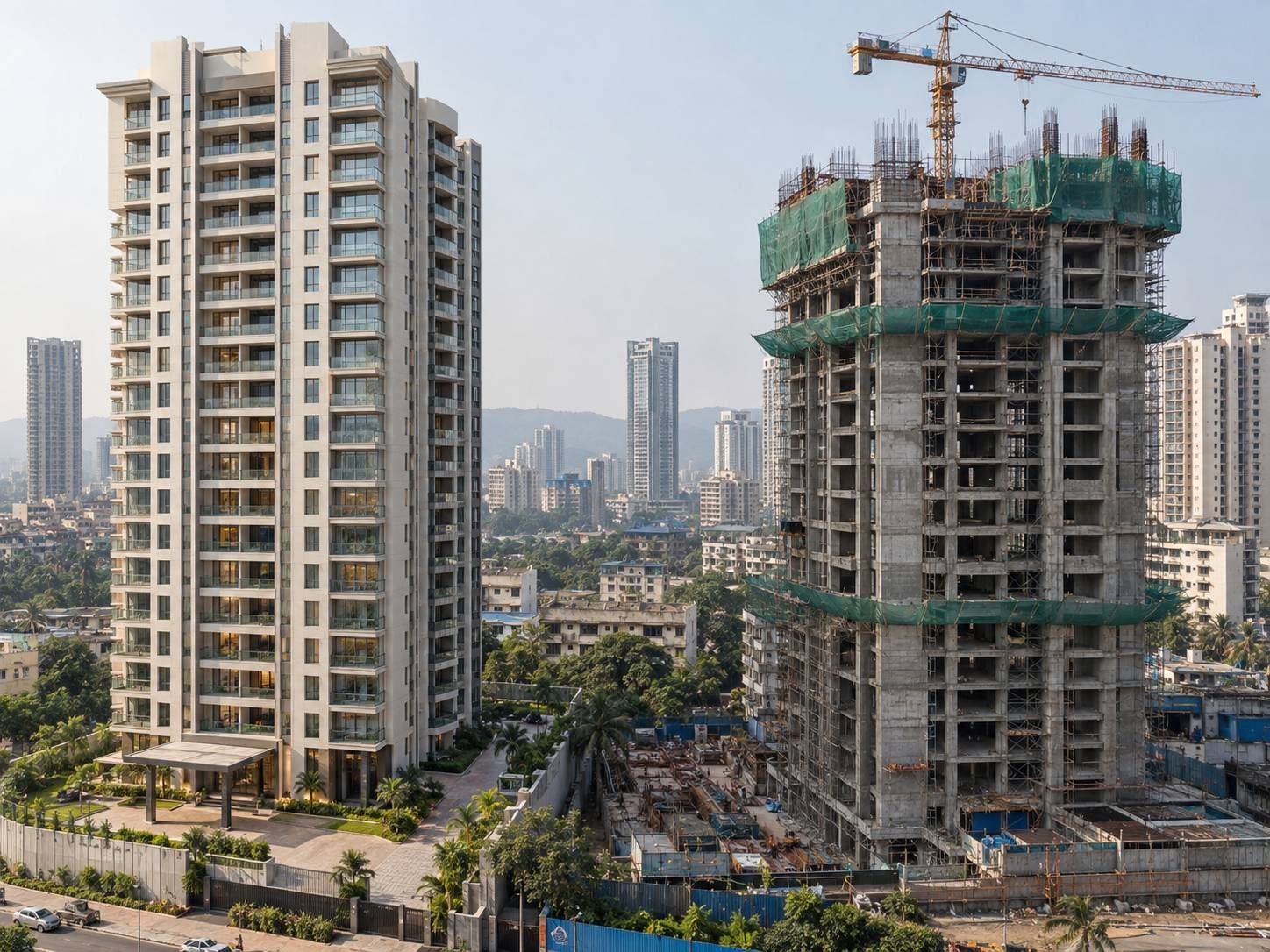
A ready-to-move property has received its Occupancy Certificate (OC) or Completion Certificate (CC) from the local municipal authority. That certificate confirms the building is legally fit for people to live in. You can move in, get utility connections and register the flat in your name without waiting on anyone else’s construction schedule.
An under-construction property has not yet reached that stage. You buy based on a floor plan, a sample flat and a builder’s promised timeline, not a finished structure. Legally, RERA requires the builder to register the project, disclose the carpet area accurately and commit to a possession date. What it cannot do is guarantee that date will be met.
The GST difference most buyers get wrong
This is where the price gap actually starts. Ready-to-move property attracts no GST once the OC or CC is issued, since the sale is treated as a transfer of immovable property rather than a construction service. Under-construction property does attract GST, because you are technically paying for a service still being delivered.
As of 2026, under-construction flats are taxed at 5 percent GST for standard units, or 1 percent if the flat qualifies as affordable housing. To qualify, the carpet area must stay within 60 square metres in a metro city and the total price must not exceed 45 lakh rupees. GST applies on two-thirds of the agreement value, since one-third is treated as the land component, which brings the effective rate down to roughly 3.3 percent for standard units and 0.67 percent for affordable ones.
This detail matters more in Bhayander, Mira Road and Vasai than it does in South Mumbai, since a large share of 1 and 2 BHK units here fall within that 45 lakh, 60 square metre band. Many buyers in this price range end up paying the lower 1 percent rate without realising why.
| Property status | GST applicable | Condition |
|---|---|---|
| Ready-to-move, OC or CC received | 0% | Treated as sale of immovable property, no GST |
| Under-construction, affordable housing | 1% (effective ~0.67%) | Carpet area up to 60 sqm and price up to 45 lakh |
| Under-construction, standard unit | 5% (effective ~3.3%) | Applies to all other residential under-construction flats |
Stamp duty and registration charges, on the other hand, apply equally to both. In municipal corporation areas including Mumbai, Bhayander and Mira Road, stamp duty runs at 6 percent for male buyers and 5 percent for female buyers, which already includes the 1 percent metro cess. Registration adds a further 1 percent, capped at 30,000 rupees for properties above 30 lakh. So GST is the real point of difference, not stamp duty.
A worked example
Say you are comparing two similar 1 BHK flats in Vasai, each with a carpet area of 45 square metres. One is ready-to-move at 42 lakh rupees. The other is under-construction, priced at 38 lakh rupees, and qualifies as affordable housing.
- Ready-to-move: 42,00,000 base price, 0 GST, stamp duty and registration of roughly 2,94,000, total around 44,94,000
- Under-construction: 38,00,000 base price, GST at the effective 0.67 percent rate adds about 25,000, stamp duty and registration of roughly 2,66,000, total around 40,91,000
The under-construction flat still works out cheaper here, even after GST. However, the ready-to-move flat comes with zero possession risk and a full loan disbursement on day one, while the under-construction flat ties your loan to a construction schedule you do not control. The price gap is buying you a smaller number and a bigger unknown.
How buyers in Bhayander, Mira Road and Vasai should weigh this decision

The right choice often depends less on price and more on what stage of life you are buying at, and the mix of inventory across these three belts pulls in slightly different directions.
Bhayander: dense, largely ready inventory
Bhayander is one of the more built-up parts of this corridor, so a bigger share of listings here are ready-to-move or nearing completion. Buyers who need to shift immediately, particularly families relocating for school admissions or a new job, generally find better options in Bhayander’s ready inventory than in its under-construction pipeline.
Mira Road: a genuine mix
Mira Road carries a healthy spread of both categories, with several large under-construction projects from established developers alongside a growing stock of recently completed towers. Investors looking for appreciation tend to lean toward the under-construction side here, since new project launches in Mira Road have historically priced in a discount to nearby completed stock.
Vasai: where under-construction dominates
Vasai has more open land and newer project activity, so under-construction inventory outweighs ready stock by a wide margin. First-time buyers with a longer runway, say two to three years before they need to move in, are better positioned to take advantage of Vasai’s under-construction pricing than someone who needs a flat within the next few months.
When ready-to-move is the better call
- You want your full home loan disbursed and your EMI fixed from the start
- You are not comfortable tracking construction progress or chasing a builder for updates
- Need to shift within the next few months, for work, school admission or a growing family
- You want to physically inspect the flat, the building and the neighbourhood before you commit
- You are buying with borrowed funds and cannot absorb a possession delay
When under-construction is worth the wait
- Your budget is tighter and the price gap to comparable ready stock is meaningful
- You do not need to move in for at least 18 to 24 months
- You are buying primarily for appreciation rather than immediate use
- The builder has a strong, verifiable track record of delivering past projects on time
- You can stagger payments across construction milestones instead of paying the full amount upfront
A mistake worth avoiding
Some buyers choose under-construction purely because the headline price looks lower, without checking the builder’s delivery history on earlier projects. A builder who delivered their last project two years late will very likely repeat that pattern, regardless of what the new brochure promises.
Before you book anything under-construction, ask for the RERA registration number and check the promised possession date against the builder’s actual track record on past projects. If a builder has delivered on time before, that history tells you far more than any sales pitch will.
How to decide
Start with your timeline, not the price list. If you need to move within a year, ready-to-move removes the biggest risk in the transaction and the price difference is smaller than most buyers expect once GST and financing are accounted for. If you have two years or more before you need the keys, under-construction can offer a genuine price advantage, provided you verify the builder’s RERA record and delivery history before you sign anything.
Either way, get the carpet area, the RERA number and the payment schedule checked before you pay a booking amount, not after. We verify all three on every project we present, and we can walk you through the numbers for any specific property you are considering in Bhayander, Mira Road or Vasai.