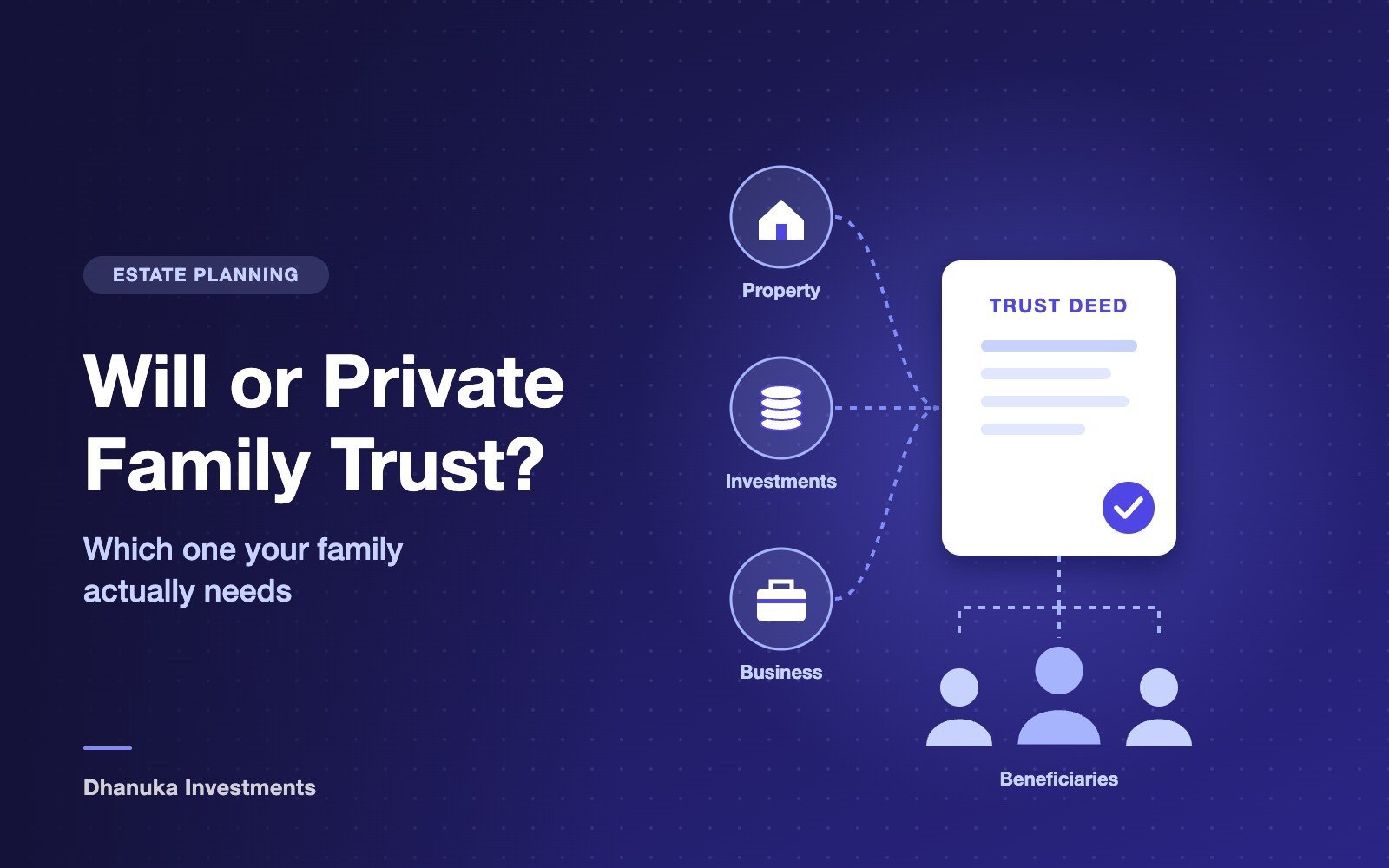
Most families assume a will settles everything. For most families, it does. But a will only speaks after you are gone, it can be challenged, and in Mumbai it often has to go through court before your children can even transfer the flat. For some families, that gap is exactly where things go wrong. That is why private family trusts are coming up in so many conversations.
This guide explains what a will does, what a private family trust does, how each is taxed and run, and which families genuinely need a trust. It is written for people who have built up property and investments over the years and want them to reach the right people, in the right way. If you are still building that base, our investment page is a better place to start.
What a will does, and where it falls short
A will is a written document that says who gets what after your death. In India it must be signed by you and attested by at least two witnesses. Registering it is optional, though registration makes it harder to dispute later. You can change or replace a will at any time while you are alive.
A will has three limits that people often discover too late:
- It works only after death. It cannot manage money for you if you become unwell, or set rules for how your family receives support over many years.
- It can take time to act on. In Mumbai, a will often needs probate, a court process that confirms the will, before property can be transferred. This can take months and has its own costs.
- It can be challenged. Family members who feel left out can contest a will, and those disputes can freeze assets for years.
What a private family trust is
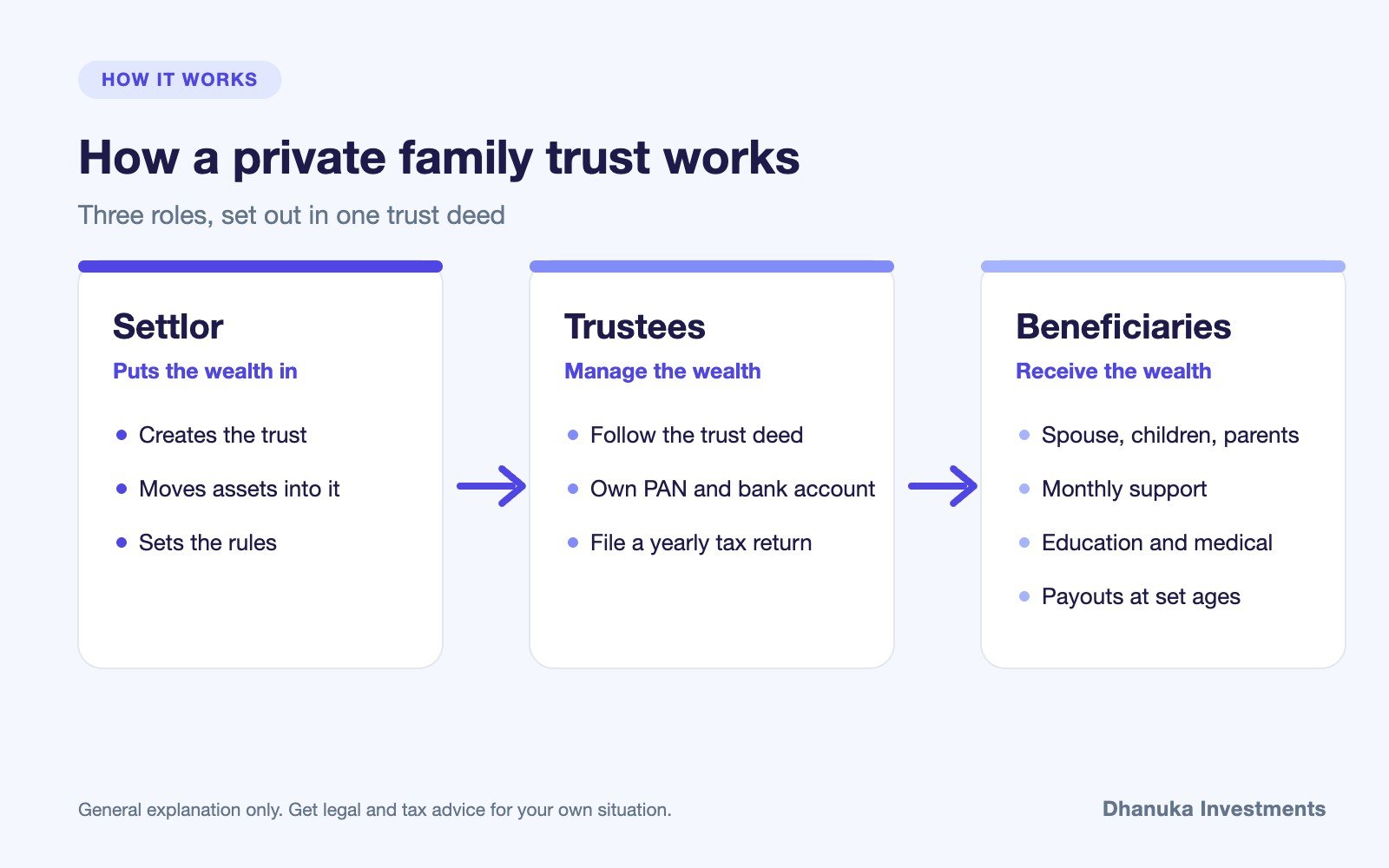
A private family trust is an arrangement where you place assets, such as property, shares, mutual funds or business holdings, under the control of trustees who manage them for your chosen family members. It is set up through a trust deed and is governed by the Indian Trusts Act, 1882.
Every family trust has three roles:
- Settlor: the person who creates the trust and moves assets into it, usually the senior member of the family.
- Trustees: the people who manage the trust strictly as the trust deed says. They can be family members, trusted professionals or a corporate trustee.
- Beneficiaries: the people the trust is created for, such as a spouse, children, grandchildren or parents.
A trust gets its own PAN and its own bank account. Unlike a will, it starts working the day it is set up, and it can follow rules you design: a monthly allowance, education and medical costs, or larger payouts only at certain ages.
Will vs private family trust, side by side
| Will | Private family trust | |
|---|---|---|
| When it works | Only after death | From the day it is set up, during your life and after |
| Court process in Mumbai | Probate is often needed | Not needed for assets already in the trust |
| Control over how heirs receive money | Limited, assets usually pass in one go | Detailed, as set out in the trust deed |
| Risk of family disputes | Can be contested | Harder to contest, though not impossible |
| Privacy | Becomes part of court records if probated | Stays private |
| Set-up cost | Low | Higher: legal drafting, stamp duty, registration |
| Ongoing work | None until death | Annual tax return, accounts and trustee decisions |
How a family trust is taxed, in simple terms
The tax treatment depends mainly on how the trust deed describes the beneficiaries.
- Specific trust: the beneficiaries and their shares are clearly fixed. Income is broadly taxed as if each beneficiary had earned their share.
- Discretionary trust: trustees decide who gets how much each year. Income is generally taxed at the maximum marginal rate, with some exceptions.
The trust files its own income tax return every year. Moving assets into a trust can also have stamp duty and tax consequences depending on the asset and who the beneficiaries are, so these need to be checked before anything is transferred.
Which families actually need a trust
For most families with a home, some savings and a clear set of heirs, a properly written and registered will is enough. A trust starts to make sense when the situation is more complicated than “everything goes equally to my children”.
Situations where a trust is worth considering
- Several kinds of assets: multiple properties, a business, listed and unlisted shares, or assets in more than one country.
- A family business: you want succession to happen smoothly, without the business being split or stuck between heirs.
- A child with special needs: who will need money managed for them for life, rather than receiving a lump sum.
- Children living abroad: where a trust can make managing Indian assets simpler for NRI heirs.
- Minor children or grandchildren: who should receive support over time, not everything at 18.
- Possible family disputes: joint families, second marriages or strained relationships where a will is likely to be challenged.
- Protecting an heir from themselves: when someone in the family may not handle a large inheritance well.
What setting up a trust involves
| Step | What it means |
|---|---|
| 1. Decide the purpose | Which assets go in, who benefits, and the rules for payouts |
| 2. Draft the trust deed | Prepared by a lawyer who handles trusts and succession |
| 3. Pay stamp duty and register | Required if property is placed in the trust; the stamp duty depends on the state and how the deed is drafted |
| 4. Get a PAN and bank account | The trust operates as its own entity |
| 5. Transfer the assets | Property, investments and other holdings are moved into the trust’s name |
| 6. Run it every year | Accounts, income tax return and trustee decisions as per the deed |
If property is going into the trust, the same title checks you would do before buying a flat apply here too. Our guide to documents to verify for a Mumbai property covers the basics.
A mistake worth avoiding
The most common mistake is creating a trust and never moving assets into it. A trust deed on its own protects nothing; only what is actually transferred is covered. The second mistake is assuming a trust makes assets untouchable. Transfers made to avoid existing creditors or obligations can still be challenged. And even with a trust, keep a will for anything that stays outside it, so nothing is left without instructions.
What to do next
List what you own, who depends on you, and what could realistically go wrong when you are not around. If the answer is simple, a registered will is probably enough. If it includes a business, a dependant with special needs, heirs abroad or a likely dispute, a family trust deserves a serious look.
Not sure which side your family falls on? Talk to us, and we will help you think it through and figure out the right next step for your family.