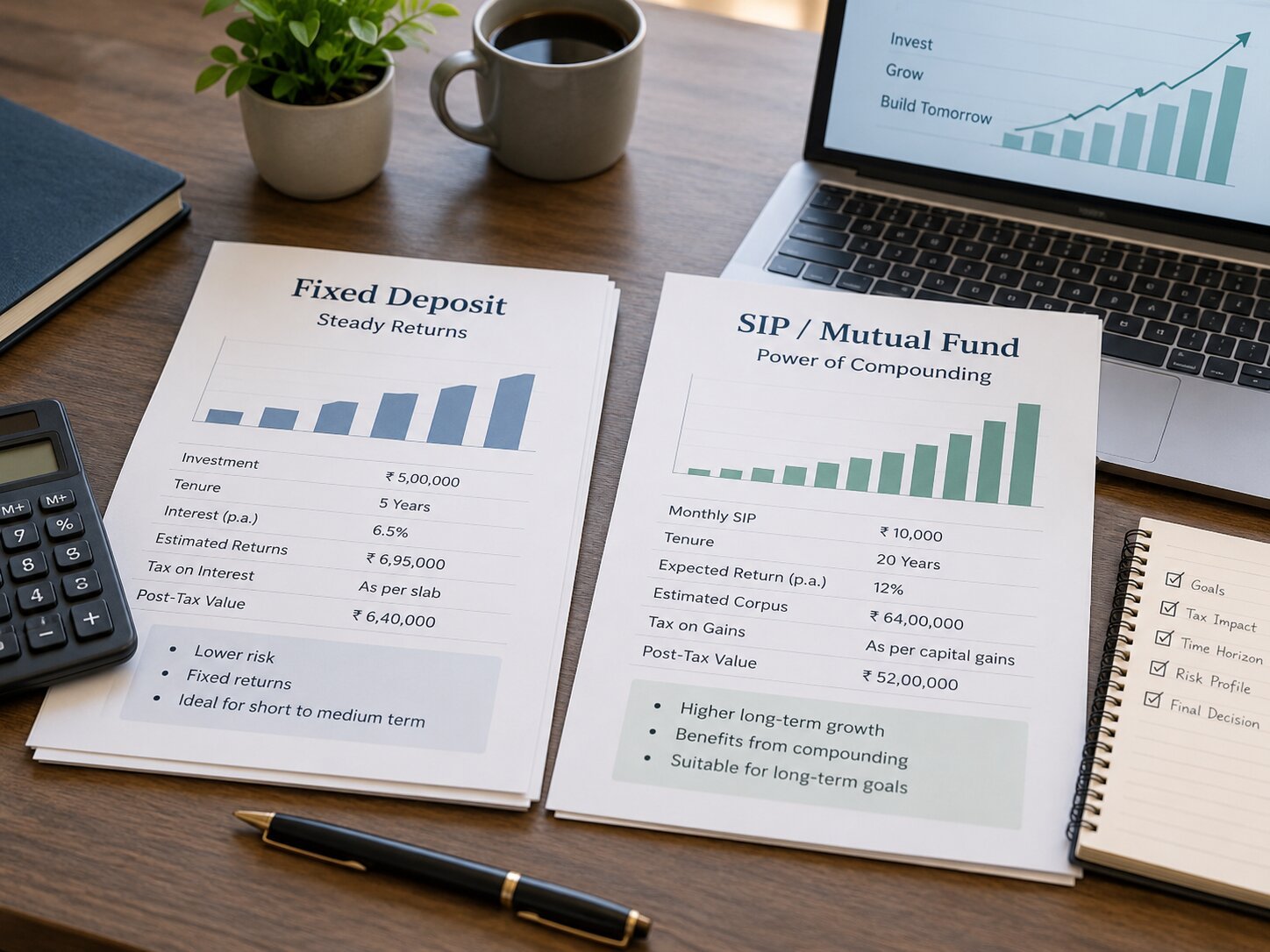
Ask ten people where their first ₹10,000 should go, and eight will say fixed deposit, because it feels safe. That safety has a real cost, and almost nobody sits down to calculate what it actually is. A SIP is not automatically the better choice either. It carries risk an FD does not, and pretending otherwise does new investors no favours.
This guide compares SIP and fixed deposit on the things that actually matter: returns, tax, liquidity and risk. It is written for someone deciding where their first real investment should go, not for someone who already has a diversified portfolio.
What a fixed deposit actually gives you
A fixed deposit locks a sum of money with a bank for a fixed period, at a fixed interest rate, decided the day you open it. Whatever happens to markets or the economy afterward, that rate does not change for the duration of the deposit.
As of September 2026, major banks offer roughly 6.25 to 6.5 percent per year on a 1 to 3 year deposit, though small finance banks often price meaningfully higher. That rate is fully known in advance, which is precisely what makes an FD attractive to someone who cannot afford surprises.
What a SIP actually gives you
A Systematic Investment Plan invests a fixed amount into a mutual fund every month, most commonly an equity fund. Unlike an FD, the return is not fixed and is not promised by anyone, including us.
What a SIP does offer is exposure to market growth over time, plus the benefit of rupee cost averaging, since a fixed monthly amount buys more units when prices fall and fewer when prices rise. Over long periods, equity markets have historically delivered higher average returns than fixed deposits, but that history is not a guarantee for your specific ten years.
| Factor | Fixed Deposit | SIP (equity mutual fund) |
|---|---|---|
| Return | Fixed, known in advance, roughly 6.25 to 6.5% currently | Market-linked, not guaranteed, varies year to year |
| Risk | Very low, principal is protected | Moderate to high, value can fall in the short term |
| Liquidity | Locked in, early withdrawal usually costs a penalty | Most funds allow withdrawal anytime, at that day’s value |
| Taxation on gains | Interest taxed every year at your income slab rate | LTCG at 12.5% above ₹1.25 lakh a year, after 1 year holding |
| TDS | 10% once annual interest crosses ₹50,000 (₹1 lakh for seniors) | No TDS on redemption for resident investors |
| Minimum to start | Varies by bank, often ₹1,000 or more | As low as ₹500 a month with most fund houses |
The tax difference that changes the math more than people expect
This is where an FD quietly loses ground. Interest earned on a fixed deposit is added to your income and taxed every year at your slab rate, whether or not you touch the money. Someone in the 30 percent tax bracket loses close to a third of their FD interest to tax, year after year, even while the money stays locked away.
Equity mutual funds work differently. Gains are taxed only when you sell, not as they accrue. Once you have held the units for more than a year, the first ₹1.25 lakh of gains in a financial year is completely tax-free, and only the amount above that is taxed, at a flat 12.5 percent, regardless of your income slab. For most investors, that combination works out considerably lighter than annual slab-rate taxation on FD interest.
A worked example
Say you invest ₹10,000 a month for 10 years, a total of ₹12 lakh invested either way.
- Fixed deposit at roughly 6.3% a year: grows to approximately ₹16.7 lakh, a gain of about ₹4.7 lakh, taxed annually at your slab rate as it accrues
- SIP at an illustrative 12% a year, a historical average and not a guaranteed figure: grows to approximately ₹23.2 lakh, a gain of about ₹11.2 lakh
Even after applying the ₹1.25 lakh annual exemption and 12.5% LTCG tax to the entire SIP gain in one illustrative calculation, roughly ₹1.25 lakh in tax, the SIP still ends up around ₹22 lakh after tax, well ahead of the FD’s pre-tax ₹16.7 lakh. This is an illustration, not a promise. A real 10-year stretch could return more or less than 12 percent, and some years could show a loss.
How to decide between the two for your own money

The right answer depends less on which product is “better” and more on what the money is actually for, and over what time frame you need it.
When a fixed deposit is the right choice
- You need the money within the next 1 to 3 years, for a known expense
- This is your emergency fund, and certainty matters more than growth
- You cannot tolerate seeing the value drop, even temporarily
- You are close to a goal and cannot afford a bad year right before you need the funds
When a SIP is the right choice
- You can leave the money untouched through market ups and downs
- Your goal is at least 5 to 7 years away, ideally longer
- You are building long-term wealth, not parking money for safety
- You are comfortable that the return is not promised, only historically likely
A mistake worth avoiding
Some first-time investors treat this as an either-or decision, when it rarely should be. Your emergency fund and any money needed within 3 years belongs in something safe and liquid, an FD or a liquid fund, regardless of what the rest of your portfolio looks like. Long-term goals are a separate pool of money, and that pool is where a SIP does its real work.
Putting your entire emergency fund into equity SIPs, or locking a 10-year goal entirely into FDs, are both versions of the same mistake: mismatching the product to the timeline.
What to do next
Separate your money by timeline before you separate it by product. Anything you need within 3 years goes toward safety. Anything you do not need for 5 years or more can afford to take on market risk in exchange for higher long-term growth potential.
Our SIP calculator and fixed deposit calculator can show you real numbers for your own amount and timeline in a couple of minutes. If you want help deciding how to split money across both, we are happy to walk through it with you.