A ₹5 lakh health policy felt like plenty a few years ago. Today a heart procedure or a week in the ICU at a big Mumbai hospital can cross that in one admission. Most families know their cover is too small, but buying a ₹25 lakh plan from scratch looks expensive. A super top-up is the cheaper way to close that gap, and very few people use it.
This guide explains what a super top-up health policy is, how it differs from a normal top-up, and how to pick the right deductible for your family. If you are reviewing your family’s cover in general, our article on 5 insurance mistakes every Indian family makes is a good place to start.
What a super top-up policy is
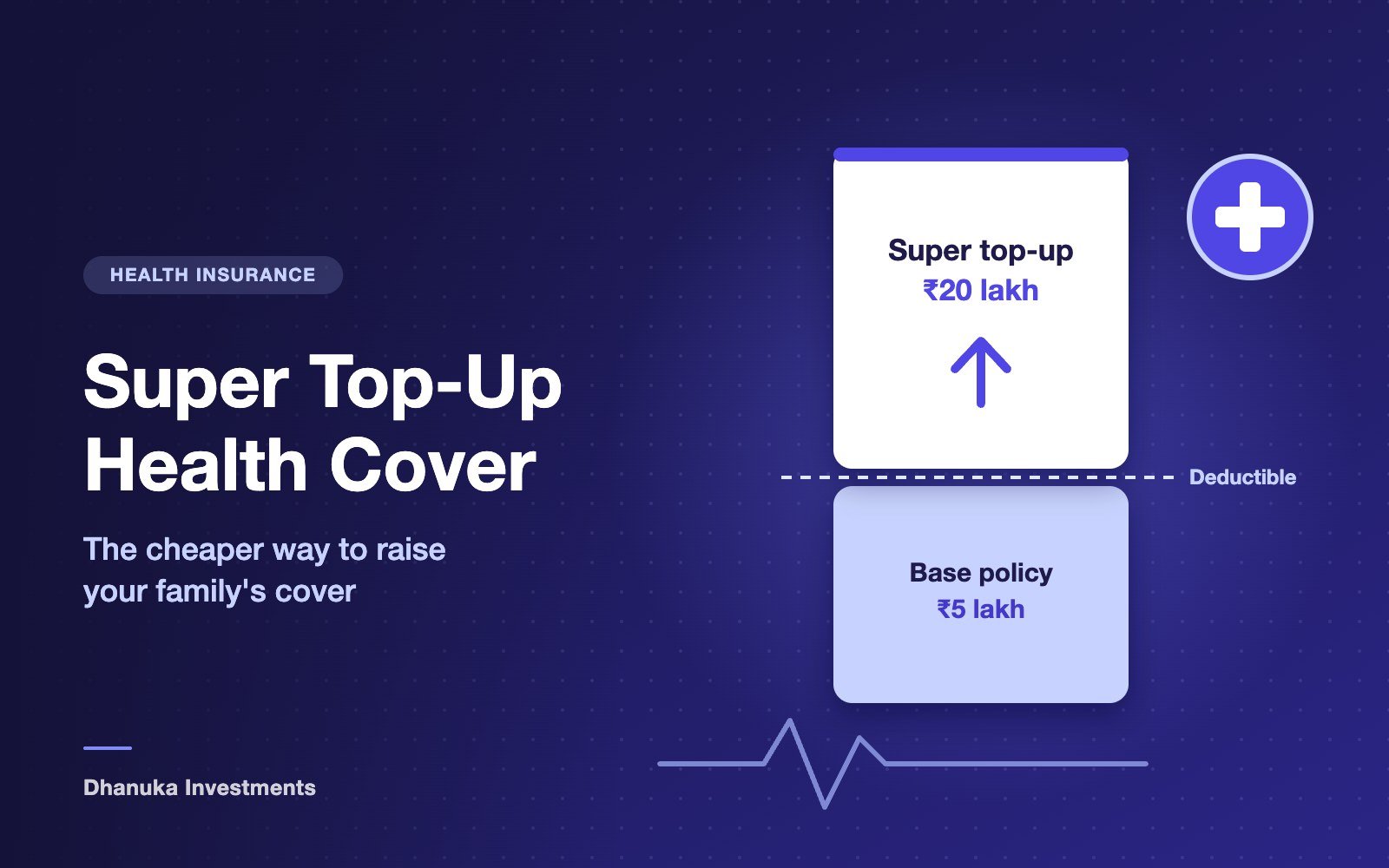
A super top-up is a health policy with a deductible. The deductible is the amount of hospital bills in a policy year that the super top-up does not pay. Once your total bills for the year cross that amount, the super top-up pays the rest, up to its own sum insured.
For example, a super top-up of ₹20 lakh with a ₹5 lakh deductible does nothing until your bills for the year cross ₹5 lakh. After that, it pays up to ₹20 lakh more. The first ₹5 lakh is usually paid by your base health policy or your employer’s cover.
Because the insurer only pays after the deductible, the premium is much lower than for a regular policy with the same total cover.
Top-up vs super top-up
The two sound the same, but they work differently, and the difference matters when a family has more than one hospital stay in a year.
| Top-up | Super top-up | |
|---|---|---|
| How the deductible works | Applies to each claim separately | Applies to the total of all claims in the policy year |
| Pays when | A single hospital bill is bigger than the deductible | Your bills for the year, added together, cross the deductible |
| Two smaller hospital stays in a year | May pay nothing | Pays once the total crosses the deductible |
| Premium | Lower | A little higher, usually worth it |
For most families, a super top-up is the better choice. Illness rarely comes as one big bill. It is often a surgery, then a follow-up admission a few months later.
A worked example for a family of four
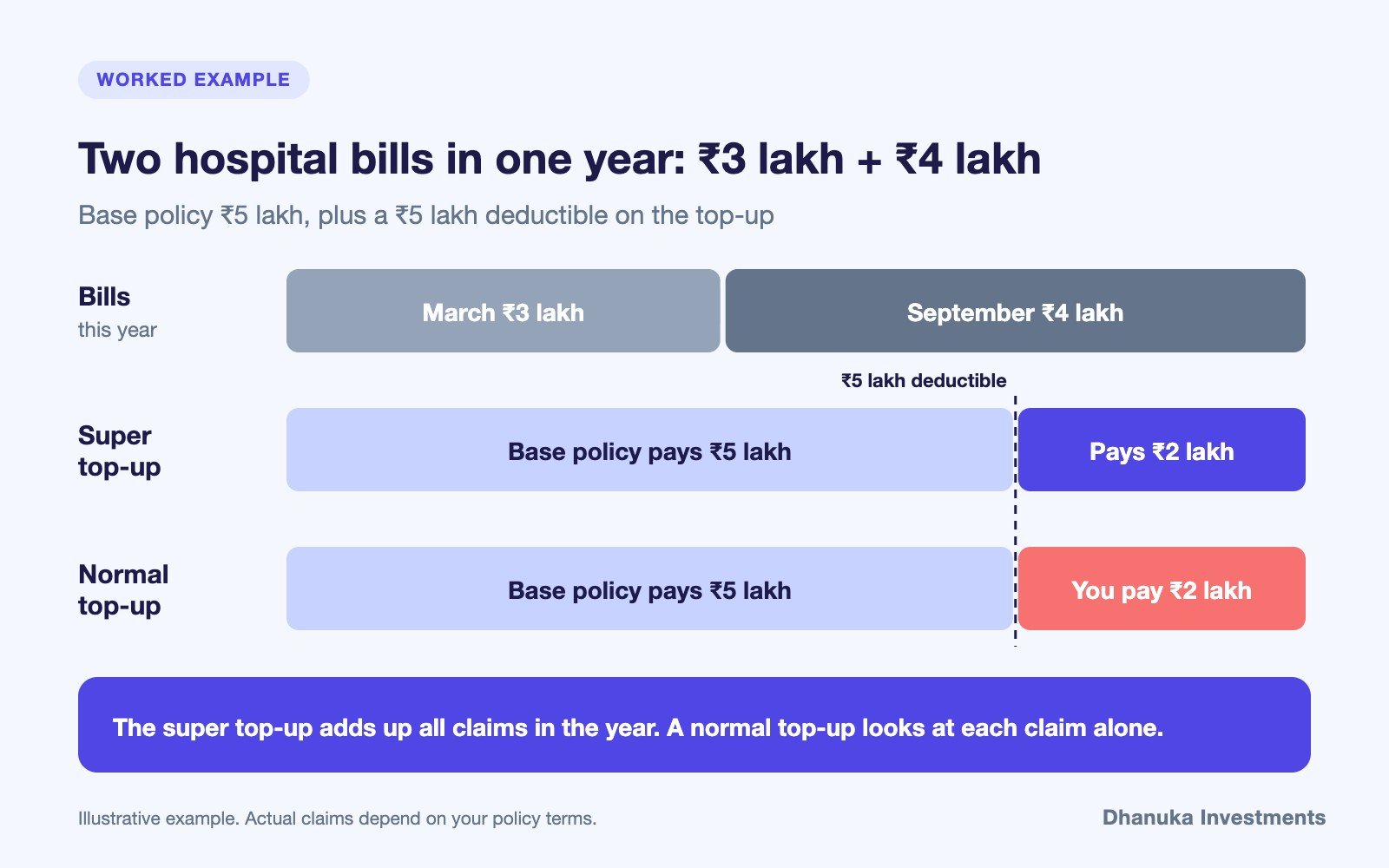
Say a family in Thane has a ₹5 lakh family floater as their base policy, and a ₹20 lakh super top-up with a ₹5 lakh deductible. In one policy year, one parent is admitted in March with a bill of ₹3 lakh, and again in September with a bill of ₹4 lakh.
| March bill ₹3 lakh | September bill ₹4 lakh | Total | |
|---|---|---|---|
| Base policy (₹5 lakh) | Pays ₹3 lakh | Pays ₹2 lakh, cover used up | ₹5 lakh |
| Super top-up (₹5 lakh deductible) | Pays nothing | Pays ₹2 lakh | ₹2 lakh |
| Paid from the family’s pocket | Nil | Nil | Nil |
With a normal top-up that had a ₹5 lakh deductible per claim, neither bill would have crossed ₹5 lakh on its own. The top-up would have paid nothing, and the family would have paid the last ₹2 lakh themselves.
Do you need a base policy first?
No. You can buy a super top-up without any base policy, and it does not have to be from the same insurer as your base policy. But without a base policy, you would have to pay the full deductible yourself before the super top-up starts paying. That is why most people pair it with a base policy whose cover matches the deductible.
How to choose the deductible and the cover
The whole plan works only if the deductible is covered. The simple rule is to keep the deductible equal to, or a little below, the base cover you hold in your own name.
- Base cover of ₹5 lakh: choose a ₹5 lakh deductible. A ₹3 lakh deductible costs a little more but leaves no gap at all.
- Total cover: for a family in Mumbai or its suburbs, a combined cover of ₹20 lakh to ₹30 lakh is a sensible target today, given what large hospitals charge.
- Room rent limits: check whether the super top-up caps room rent. A cap can cut the claim on every item of the bill, not just the room charge.
- Waiting periods: a new super top-up has its own waiting periods, including for illnesses you already have. Under current IRDAI rules, the waiting period for pre-existing diseases cannot be more than three years.
- Age and renewal: buy while everyone is healthy. Premiums rise with age, and a new policy after a diagnosis is harder to get.
What it costs, and the GST change
The premium depends on age, city, deductible and cover, so there is no single figure. In most cases, though, a ₹20 lakh super top-up costs a fraction of what a ₹20 lakh base policy would.
Since 22 September 2025, health insurance bought by individuals and families, including super top-ups, carries no GST. Earlier, 18% was added to the premium. Group policies bought by employers still carry GST.
Mumbai, Thane, Mira Road and Vasai: why cover size matters
Hospital costs vary a lot across the region. Large private hospitals in South and Central Mumbai charge more for the same treatment than many hospitals in Mira Road, Bhayander or Vasai. But in a serious case, families often move the patient to a bigger hospital in the city. Plan your cover for the hospital you would actually choose in an emergency, not the one closest to home.
A mistake worth avoiding
Many salaried people buy a super top-up with a deductible equal to their employer’s group cover, and no personal base policy. It works while they are in that job. When they change jobs, take a break or retire, the group cover ends, and they suddenly have to pay the full deductible themselves before the super top-up pays anything. Keep a personal base policy that matches the deductible, and treat employer cover as an extra.
What to do next
Check the cover you have today, in your own name and through your employer. If it is below ₹20 lakh for the family, a super top-up is usually the cheapest way to raise it. Choose a deductible that your base policy fully covers, and buy before anyone in the family develops a new health condition.
If you would like help with this, our insurance team can call you back with super top-up plans that fit your existing policy. For protecting your family’s income as well, read our guide on term vs whole life insurance.