
Most families who buy a whole life policy believe they have bought protection and savings in one product. In practice, many end up with too little of both: a cover amount that would not last their family a few years, and returns that barely beat a bank deposit. A term plan feels like “money gone” because it pays nothing if you survive. That feeling is exactly why so many people choose the wrong one.
This guide compares term and whole life insurance on what actually matters to a family: how much cover you get, what it costs, what comes back, and how tax treats it in 2026. If you have not read it yet, our piece on 5 insurance mistakes every Indian family makes is a good companion to this one.
What term insurance gives you
A term plan is pure protection. You choose a cover amount and a period, say ₹1.5 crore until age 60. If you pass away during that period, your family receives the full amount. If you survive the term, the policy ends and nothing is paid back.
Because there is no savings part, term insurance is the cheapest way to buy a large cover. That is its whole job: making sure your family can repay the home loan, run the house and fund the children’s education if your income stops.
Some insurers offer a “return of premium” version that refunds your premiums if you survive. It costs noticeably more than a plain term plan, and what comes back has lost value to inflation over 25 or 30 years.
What whole life insurance gives you
A whole life plan covers you for most of your life, usually up to age 99 or 100. Because the insurer is almost certain to pay out at some point, the premium is much higher than for term cover. Part of what you pay goes into a savings pool that earns a bonus or a guaranteed addition, depending on the plan.
The payout goes to your family on death, or to you if you reach the policy’s end age. Many plans also let you take partial payouts or a loan against the policy later in life.
When you are shown a participating whole life plan, the insurer gives you a benefit illustration at two assumed returns, 4% and 8% a year. Neither is guaranteed. Over the long term, the effective return on traditional savings-linked policies has often been in the low to mid single digits.
Term vs whole life, side by side
| Term insurance | Whole life insurance | |
|---|---|---|
| Main purpose | Replace your income if you die early | Lifelong cover plus long-term savings |
| Cover period | Fixed term, for example until 60 or 65 | Usually up to age 99 or 100 |
| Premium for the same cover | Low | Several times higher |
| If you outlive the policy | Nothing is paid (unless you chose return of premium) | Maturity amount is paid |
| Returns | None, it is not an investment | Modest, partly guaranteed, partly bonus |
| Exiting early | You simply stop paying | Surrender value is low in the early years |
| Best for | Almost every earning member with dependants | Specific needs, explained below |
What has changed recently
- No GST on individual life insurance. Since 22 September 2025, premiums on individual life policies, including term plans, carry no GST. Earlier, term premiums attracted 18%.
- Better surrender value. Since 1 October 2024, insurers must pay a special surrender value even if you exit after the first policy year, as long as the full first-year premium was paid. It is still well below what you paid in the early years.
- New tax law, same deduction. From 1 April 2026, the old Section 80C deduction sits under Section 123 of the Income-tax Act, 2025. The ₹1.5 lakh limit is unchanged, but it is available only if you choose the old tax regime. The new regime, which is now the default, does not allow it.
- Large premiums can make maturity taxable. For non-linked policies issued on or after 1 April 2023, the maturity amount becomes taxable if your total annual premium across such policies is above ₹5 lakh. The amount paid to your family on death remains tax-free.
How to decide for your own family
Start with one question: if your income stopped tomorrow, how much money would your family need to stay where they are? That number is your cover target. The product choice comes after.
How much cover you actually need
A simple starting point is 10 to 15 times your annual income, plus any outstanding loans, plus big goals like a child’s education. Our term insurance cover calculator works this out from your own numbers in a couple of minutes.
What this looks like for a family in Mira Road or Vasai
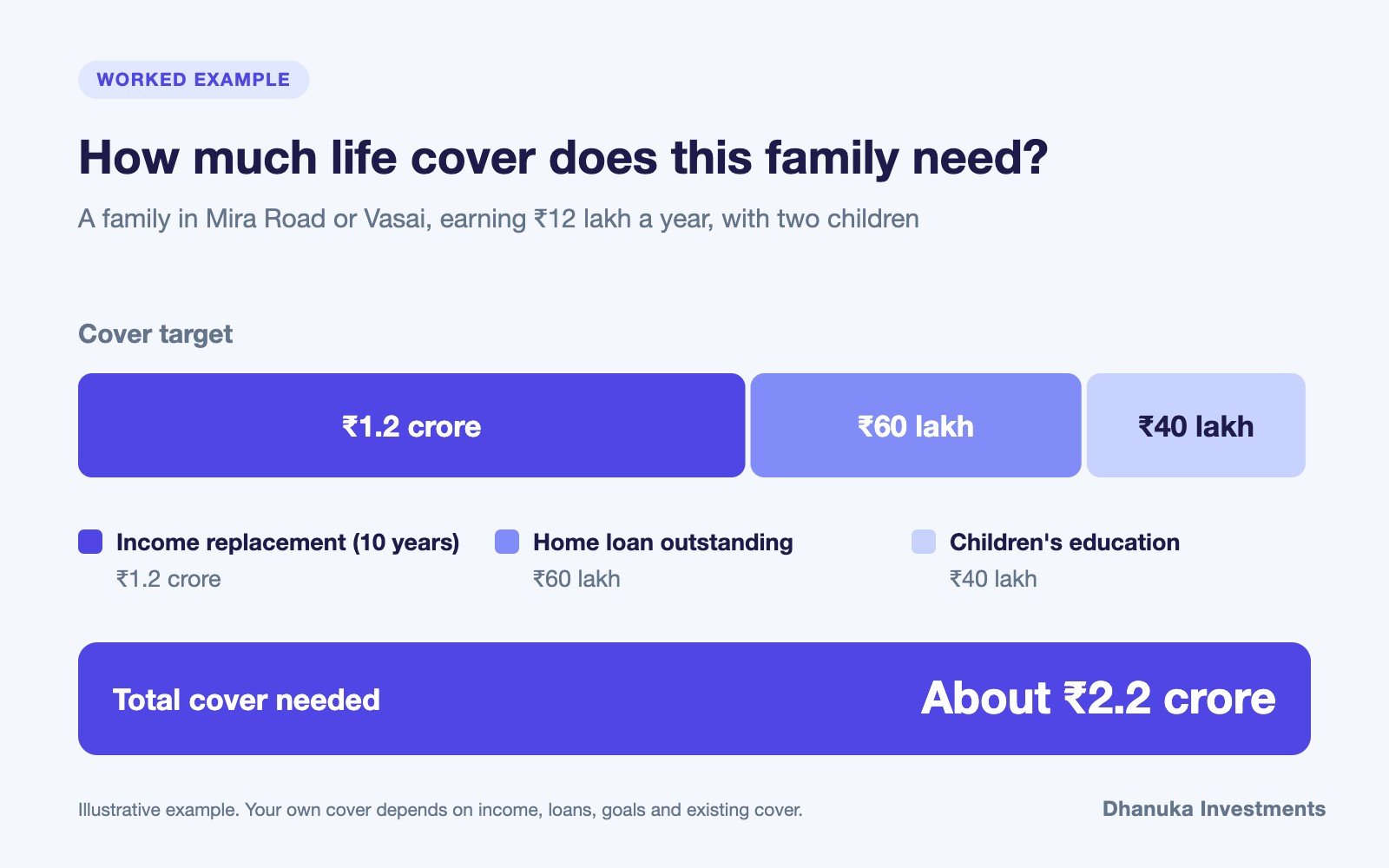
| Example family | |
|---|---|
| Annual income | ₹12 lakh |
| Home loan outstanding | ₹60 lakh |
| Two children, education fund needed | ₹40 lakh |
| Income replacement (10 years) | ₹1.2 crore |
| Suggested cover | About ₹2.2 crore |
A term plan for ₹2.2 crore is affordable for most salaried families. Buying the same cover through a whole life plan would cost so much that most families cut the cover down instead, and that is where the real risk begins.
A worked example: term plus investing the difference
Suppose a whole life plan quotes you ₹1,00,000 a year and a term plan for similar cover quotes ₹15,000. If you buy the term plan and put the ₹85,000 difference into a monthly SIP of about ₹7,080, at an assumed 10% a year that could grow to roughly ₹95 lakh in 25 years.
That return is not guaranteed and it needs discipline: the money has to actually be invested every month and left alone. You can test your own numbers with our SIP calculator. For most families, though, this route gives both bigger protection today and more flexibility later.
When whole life can make sense
- You want to leave a guaranteed amount to your children or grandchildren whenever you pass away, not only if it happens before 60.
- You have a dependant who will need support for life, such as a child with special needs.
- You already have enough term cover and want a conservative, partly guaranteed savings product on top.
- You know you will not invest the difference on your own, and a forced savings habit is worth the lower return to you.
A mistake worth avoiding
The costly mistake is using a whole life or endowment plan as your main protection. A family might pay ₹1 lakh a year for ₹15 lakh of cover and feel well insured, when the same budget could buy cover of several crores through a term plan. The second mistake is surrendering a whole life policy in its early years after realising this. Exiting early usually loses a large part of what you paid, so fix the cover gap with a term plan first, then decide calmly what to do with the existing policy.
What to do next
Work out your cover target first, then choose the product. For most earning members with dependants, that means a term plan for the core cover, with investments handled separately.
If you would like help choosing a term plan, or deciding what to do with a policy you already hold, our insurance team can go through the options with you on a call.